Magnetic continuously variable transmission
A simulation study comparing NdFeB, ferrite and hybrid magnet designs for a magnetic continuously variable transmission.
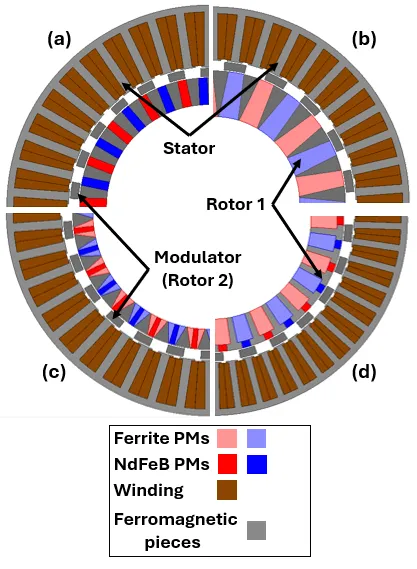
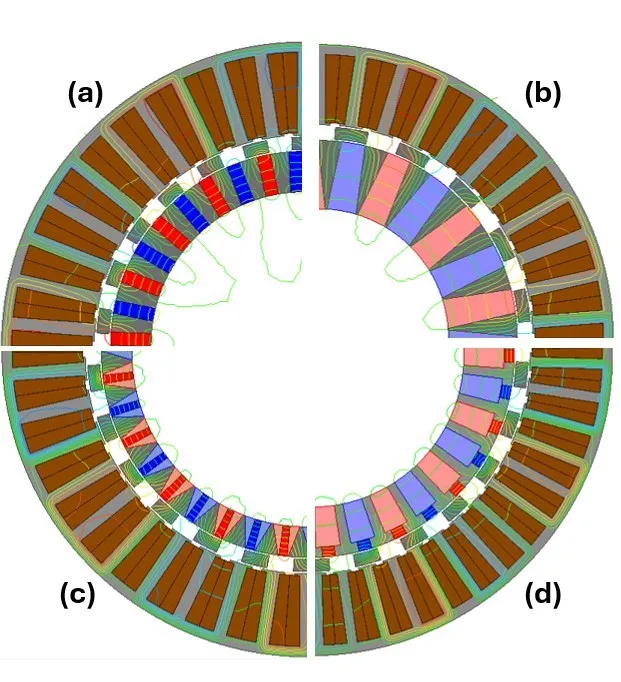
A magnetic continuously variable transmission (MCVT) gives a variable gear ratio without contact, which can connect a fixed speed machine to variable speed motion. Rare earth magnets like NdFeB give high torque density, but their cost and limited availability are a concern. Ferrite magnets are less expensive and much weaker. This study compared four designs: NdFeB only, ferrite only, and two hybrids that use both (Fig. 1). If you are new to magnetic gears, this short background may help.
Method
- All four designs have a flux focusing inner rotor, a modulator rotor and a wound stator, with an outer radius of 150 mm, 1 mm air gaps and a current density of 10 A/mm²
- We swept the geometry of each design in 2D FEA, with the stack length scaled to reach 250 N·m on the modulator rotor
- The best designs were then simulated in 3D to capture end effects, and in 2D transient simulations for torque ripple, losses and efficiency
Results
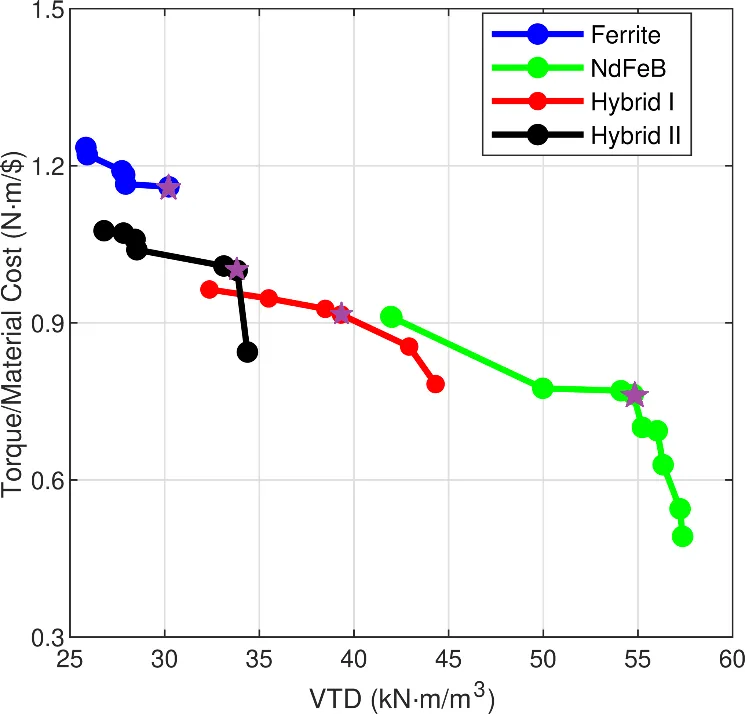
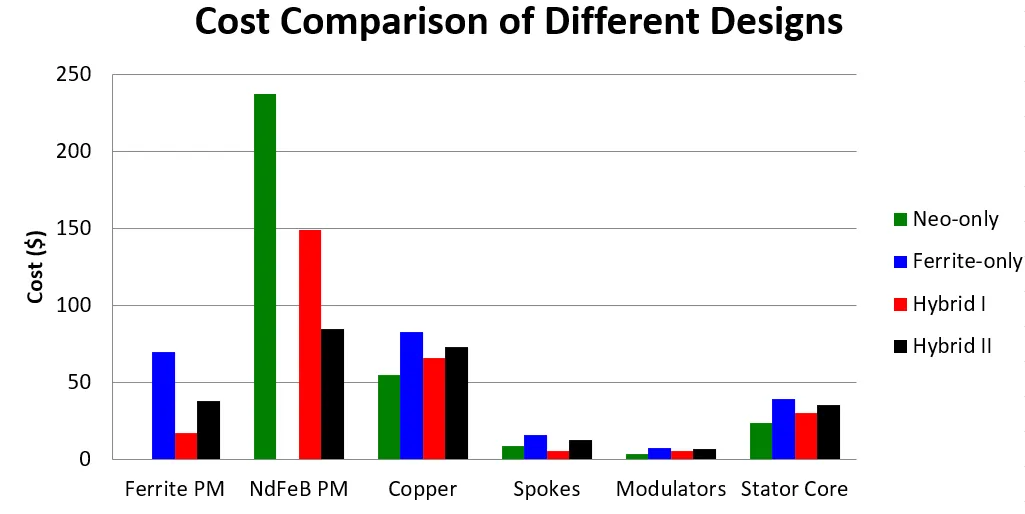
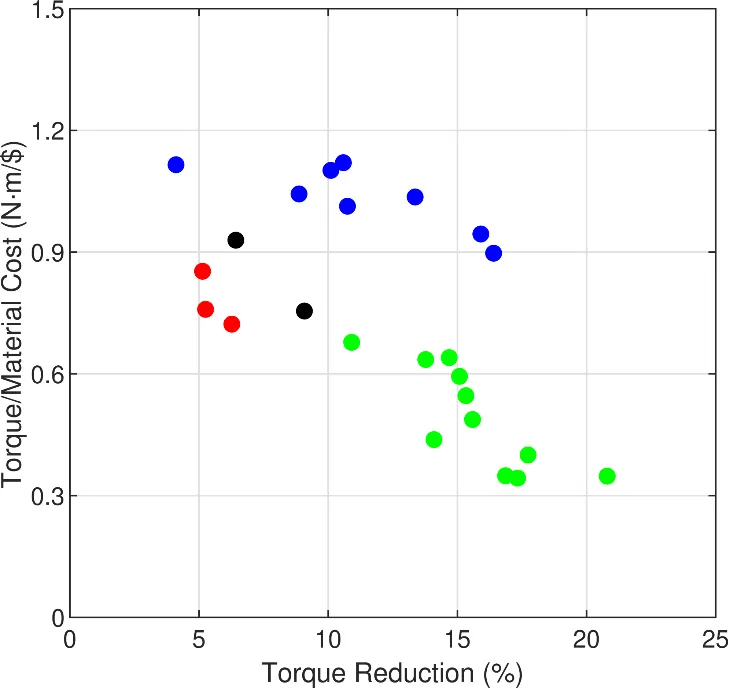
- The NdFeB only designs reach the highest volumetric torque density, at a significantly higher material cost
- The ferrite only designs give the most torque per dollar of material, with a lower torque density
- Both hybrids land in between. Putting the ferrite magnets in series with the NdFeB magnets gives a higher torque density and a higher cost than putting them in parallel
- The hybrid designs lose less torque from 2D to 3D
- Torque ripple was below 3.5% for all the designs on the Pareto front
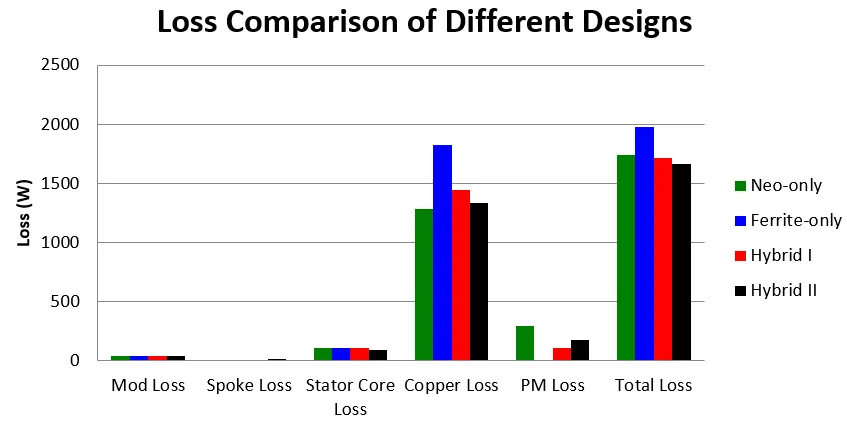
- All the designs were over 92% efficient at the evaluated speed. Copper loss dominates, so the ferrite designs are slightly less efficient
Limitations
This was a simulation study and no prototype was built. The cost results also depend on the material prices assumed.
Papers
- Comparison of NdFeB, Ferrite, and Hybrid Designs for a Magnetic Continuously Variable TransmissionIEEE ECCE, 2025IEEE XplorePDF
Some figures on this page are from these papers. © IEEE.