"Raxial" flux magnetic gear
A cycloidal magnetic gear that combines the axial and radial flux topologies to cancel most of the unbalanced force on its bearings.
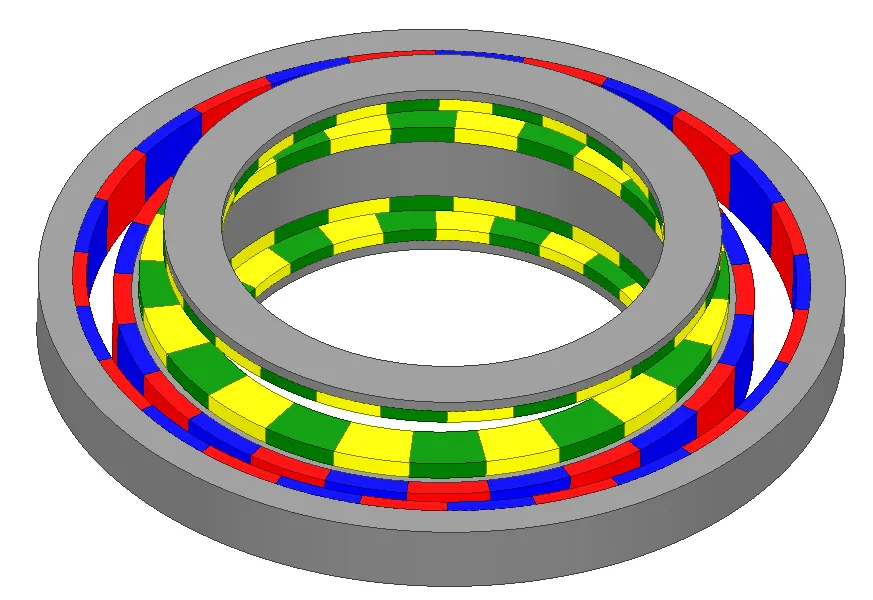
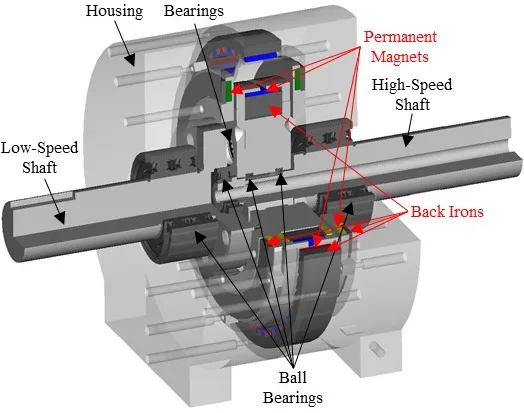
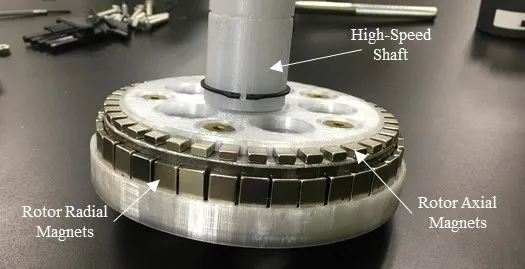
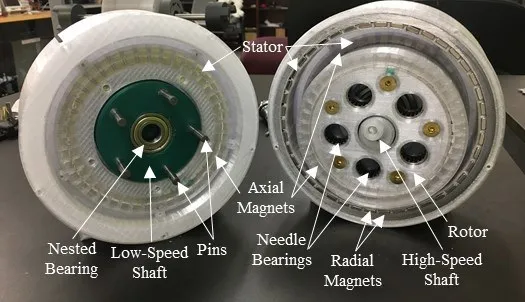
Cycloidal magnetic gears reach high gear ratios and high torque densities, but their rotors experience large unbalanced magnetic forces, which stress the bearings. This project proposed a new cycloidal topology that combines the axial flux and radial flux versions, so that the two sets of magnets pull against each other (Fig. 1). If you are new to magnetic gears, this short background may help.
The prototype was built over a six week summer camp, the 2021 CAST STEM Bridge Camp, where high school students did research at UT Dallas. That restricted us to off-the-shelf and 3D printed parts.
Work
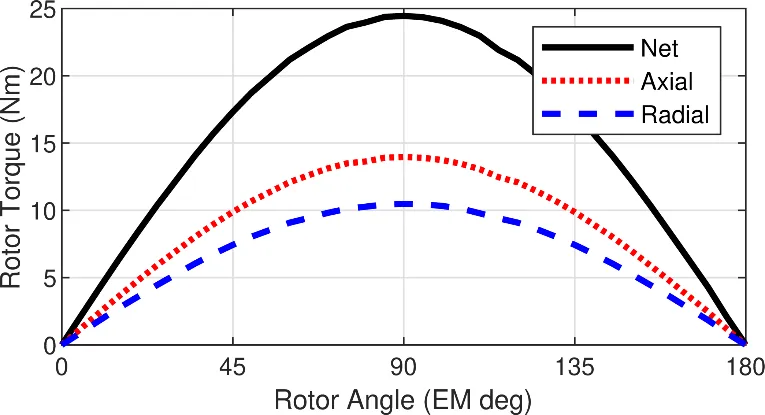
- Analyzed the torques and forces from the axial and radial magnets with 3D FEA in Ansys Maxwell
- Designed and built a proof of concept prototype with a 20:1 gear ratio
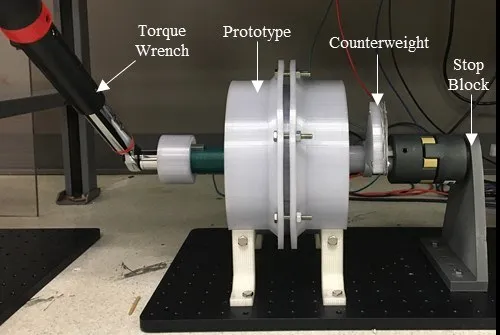
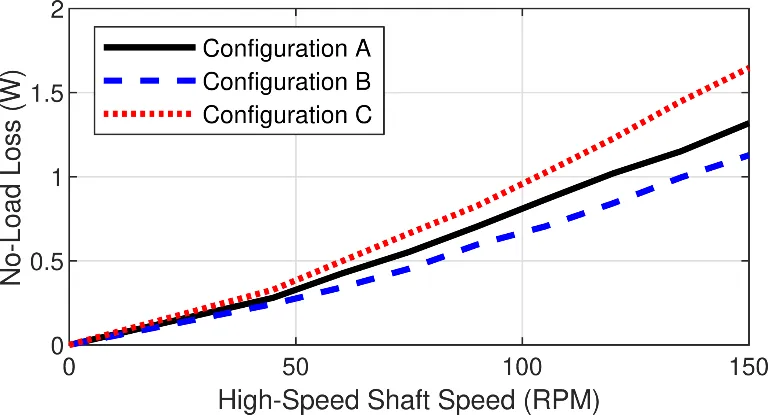
- Tested slip torque and no-load losses in three configurations: all magnets, without the axial stator magnets, and without the radial rotor magnets
Results
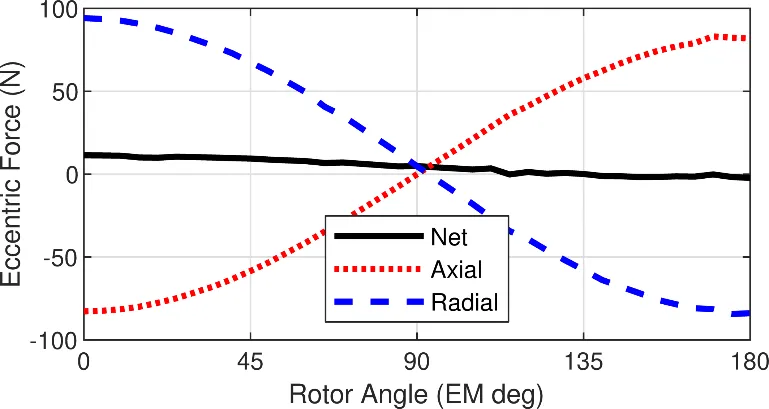
- The eccentric part of the magnetic force can be largely cancelled (Fig. 4). The perpendicular part cannot, because it is what transfers torque to the high-speed shaft
- The measured slip torque with all magnets was 20.9 N·m, within 15% of the 24.5 N·m from 3D FEA
- With both the axial and radial magnets in place, the prototype had lower no-load losses and a higher slip torque than with the axial magnets alone
Limitations
With custom machined parts, the prototype could have reached a higher slip torque, a higher torque density and lower losses. More study is needed to see how the efficiency and reliability of a better optimized design compare to conventional magnetic and mechanical gears.
Papers
- Cycloidal Magnetic Gear Combining Axial and Radial TopologiesIEEE Trans. Energy Convers., 2022IEEE XplorePDF
Some figures on this page are from these papers. © IEEE.